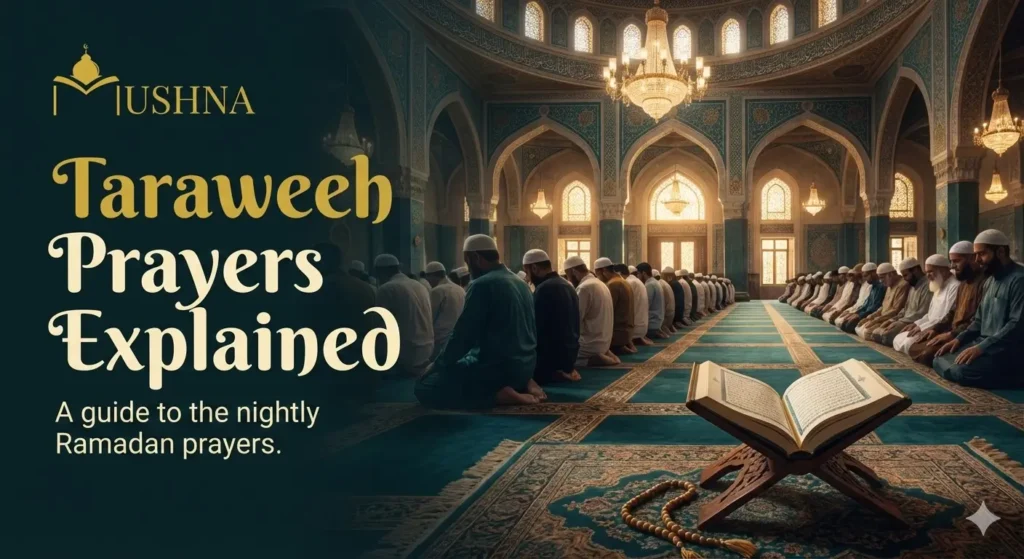
Among the distinctive acts of worship that give Ramadan its unique spiritual atmosphere, none is more recognisable — or more beloved — than the Taraweeh prayer. Performed nightly after Isha during the blessed month, Taraweeh transforms mosques around the world into sanctuaries of devotion, where worshippers stand together in the quiet hours of night, listening to the words of Allah.
The Name and Its Meaning
The word ‘Taraweeh’ (التراويح) is derived from the Arabic root r-w-h (ر-و-ح), which relates to rest, comfort, and the breathing of the soul. It is so named because of the historical practice of resting between each set of four rak’ahs, sitting and engaging in dhikr or quiet reflection. This etymology itself communicates the spirit of the prayer: it is not a sprint but a contemplative journey, a nightly pilgrimage of the heart.
Historical and Legal Foundation
The origin of Taraweeh is traced to the Prophet Muhammad (peace be upon him), who prayed at night in congregation during Ramadan on a few occasions, then deliberately withdrew from doing so regularly out of concern that it might be made obligatory upon the community. Following his passing, the companions continued to pray individually or in scattered groups.
It was during the caliphate of Umar ibn al-Khattab (may Allah be pleased with him) that the prayer was formalised into a single congregation, with Ubayy ibn Ka’b leading the people. Umar famously observed the worshippers gathered in rows and remarked: ‘What an excellent innovation this is.’ Scholars have interpreted his use of the word ‘innovation’ (bid’ah) in this context as referring to its outward organisation, not its essence, which was firmly established from the Prophetic Sunnah.
Number of Rak’ahs: A Scholarly Discussion
The question of how many rak’ahs constitute Taraweeh is among the most discussed topics in Islamic jurisprudence. The majority of classical scholars held that twenty rak’ahs is the established Sunnah of the Companions, and this was the practice widespread in the two holy mosques for many centuries. Evidence for this number is found in multiple reports from the era of Umar ibn al-Khattab and the generations following him.
A significant body of scholarship, particularly within the Hanbali tradition and reinforced by scholars like Ibn Taymiyyah and Ibn al-Qayyim, holds that eight rak’ahs is also established from the Prophetic practice, based on narrations about the Prophet’s (peace be upon him) night prayer. This position is widely adopted today, particularly in the Haramayn (the two holy mosques of Makkah and Madinah).
The scholarly consensus across all four madhabs affirms that Taraweeh is Sunnah Mu’akkadah — a confirmed, emphasised Sunnah — regardless of the number of rak’ahs. The key is presence, continuity, and sincerity.
The Khatm al-Quran: Completing the Quran
One of the most spiritually significant traditions associated with Taraweeh is the recitation of the entire Quran over the course of Ramadan. Imams divide the 30 juz’ (parts) of the Quran across the 30 nights, creating a complete traversal of the divine text that culminates in a special completion ceremony — the Khatm al-Quran — typically held during the final nights of the month.
The congregation’s experience of hearing the Quran in its entirety is described by many scholars as one of the most profound forms of engagement with the sacred text. Even for those who do not understand Arabic, the recited word carries a spiritual force that has been testified to across generations and cultures.
How to Maximise Your Taraweeh Experience
Those who wish to gain the full benefit of Taraweeh are encouraged to arrive with a clear intention (niyyah), maintain focus during recitation, and follow along with a mushaf (Quran) if possible. Reflecting even briefly on the meaning of familiar verses deepens the experience considerably. The rest periods between sets of four rak’ahs are ideal for short supplication or silent remembrance.
Conclusion
Taraweeh is among the greatest gifts of Ramadan nights. It is the community’s collective act of standing before Allah in the hours when the world is quiet and the heart is most receptive. Whether one prays eight rak’ahs or twenty, alone at home or in the front row of a great mosque, the essential reality of Taraweeh is the same: a believer standing before their Lord, in the holy month, listening to His words.